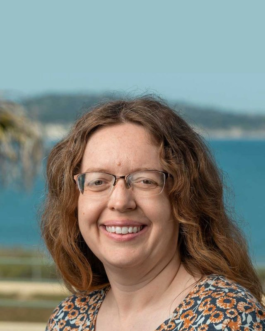

There’s a lot of plastic in the ocean. Much of it comes from the single-use items that we’re all familiar with, such as food wrappers and microbeads that inadvertently wind up in the sea. But a growing amount is coming from plastics that are actually made to be used in marine environments, such as instrumentation used for an emerging ocean “Internet of Things.”
“Oceanographic sensors are becoming cheaper and cheaper, and people don’t want to go back into the ocean and get them, so they’re basically disposable,” said UC Santa Barbara marine microbiologist Alyson Santoro, a faculty member in the Department of Ecology, Evolution and Marine Biology (EEMB). These networking devices are used by the “blue economy” — a diverse group of maritime industries including tourism, defense, transportation, fisheries, education and power generation. By enabling rapid data-gathering and communications across the many sectors and communities that use the ocean, monitoring can be enhanced, resources managed more effectively and innovative solutions accelerated.
But that doesn’t resolve the issue of long-lived plastics in the ocean, a problem that Santoro and colleagues — Anne Meyer at the University of Rochester, Melissa Omand at the University of Rhode Island, Ryan Freedman at the Channel Islands National Marine Sanctuary and partners from sustainable polymers designer Mango Materials — are trying to get ahead of. And now, with support from the National Science Foundation’s Convergence Accelerator program, the group is poised to tackle that challenge, with results that could change the way future oceangoing materials are made.
“This award will give me the opportunity to work with scientists and engineers I wouldn’t have the chance to work with otherwise, and the rare opportunity to be a student again and participate in the program’s design curriculum, where we’ll learn how to collaborate effectively as a team,” Santoro said. Her group is one of 16 teams selected for the highly competitive 2021 Cohort, Phase 1, Networked Blue Economy track of NSF’s Convergence Accelerator.
“Professor Santoro’s proposal is a visionary approach to tackling the urgent need to understand how to find solutions to plastic pollution through cross-fertilization of ideas between scientists and engineers,” said EEMB chair Debora Iglesias-Rodriguez. “Congratulations to Professor Santoro for pioneering research that could be truly transformative and open opportunities for our students.”
More updates

There’s a lot of plastic in the ocean. Much of it comes from the single-use items that we’re all familiar with, such as food wrappers and microbeads that inadvertently wind up in the sea. But a growing amount is coming from plastics that are actually made to be used in marine environments, such as instrumentation used for an emerging ocean “Internet of Things.”
“Oceanographic sensors are becoming cheaper and cheaper, and people don’t want to go back into the ocean and get them, so they’re basically disposable,” said UC Santa Barbara marine microbiologist Alyson Santoro, a faculty member in the Department of Ecology, Evolution and Marine Biology (EEMB). These networking devices are used by the “blue economy” — a diverse group of maritime industries including tourism, defense, transportation, fisheries, education and power generation. By enabling rapid data-gathering and communications across the many sectors and communities that use the ocean, monitoring can be enhanced, resources managed more effectively and innovative solutions accelerated.
But that doesn’t resolve the issue of long-lived plastics in the ocean, a problem that Santoro and colleagues — Anne Meyer at the University of Rochester, Melissa Omand at the University of Rhode Island, Ryan Freedman at the Channel Islands National Marine Sanctuary and partners from sustainable polymers designer Mango Materials — are trying to get ahead of. And now, with support from the National Science Foundation’s Convergence Accelerator program, the group is poised to tackle that challenge, with results that could change the way future oceangoing materials are made.
“This award will give me the opportunity to work with scientists and engineers I wouldn’t have the chance to work with otherwise, and the rare opportunity to be a student again and participate in the program’s design curriculum, where we’ll learn how to collaborate effectively as a team,” Santoro said. Her group is one of 16 teams selected for the highly competitive 2021 Cohort, Phase 1, Networked Blue Economy track of NSF’s Convergence Accelerator.
“Professor Santoro’s proposal is a visionary approach to tackling the urgent need to understand how to find solutions to plastic pollution through cross-fertilization of ideas between scientists and engineers,” said EEMB chair Debora Iglesias-Rodriguez. “Congratulations to Professor Santoro for pioneering research that could be truly transformative and open opportunities for our students.”
More updates
© Nereid Biomaterials. All rights reserved.
Looking to replace your current material with one of ours? Needing to design a new mold to fit the needs of your growing customer base? Looking for something completely innovative and original? Contact us and we'll figure out the next best steps together!
Pellet form coming soon!
Choose your favorite Nereid formulation to use with your existing injection mold, or purchase one of our IM goods.
Contact us to discuss which formulation will work best for your application, or to discover which products we currently have for sale.
Choose your favorite Nereid formulation to use with your existing injection mold, or purchase one of our IM goods.
Contact us to discuss which formulation will work best for your application, or to discover which products we currently have for sale.

We are a team of material scientists, microbiologists, and oceanographers working across industry, academia, and government.
Anne Meyer
Co-Founder and Living Materials Expert
We are a team of material scientists, microbiologists, and oceanographers working across industry, academia, and government.
Anne Meyer
Co-Founder and Living Materials Expert